
 UEA?
UEA?La vera aspekto de la retejo ne povas por esti korekte rigardata per via retumilo.
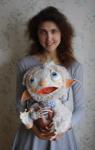
The fairy tale is humanity's oldest genre. And yet the heroes and themes of fairy tales reached our era almost unaltered. The names and décors have changed, but the morals, the psychology, the philosophical sense of fairy tales, hidden under easy external forms, came to the 21st century just as they were dozens of centuries earlier. Ancient fairy-tale themes were able to find a suitable place for themselves in different social situations, in different historical eras, in the canons of different religions, both pagan and monotheistic.
For centuries grandparents have told fairy tales to grandchildren; this is a custom, almost like breathing or eating. It was only in the 19th century that fairy tales became the material not just for storytelling and collecting but also for the scientific work of philologists and historians. The romantic era in many European countries was marked by a great interest in the past, in national roots and the paths of peoples. This trend revived interest in fairy stories as the oldest and richest source of national culture. After many years of learning and collecting it became clear that many fairy-tale themes and heroes appear almost without change in the fairy tales of different peoples. Scientists decided that this was the result of communication between peoples. So-called scientific schools of borrowing appeared, whose scientists tried to discover the original fairy tale which was later borrowed by other peoples. This research gave some results, but lost its sense entirely when the "common themes" were found in fairy tales of native peoples of America, Japan, China and Africa. Dozens of unscientific theories were born, and interest in fairy tales grew from day to day. When the wave of superstition finally died down there remained a clear, completely scientific, and still current theory that without any physical link, without any borrowing, the same fairy-tale themes were born from ordinary human life: from the love of life and the fear of death, from relationships with nature and animals, from sexual differences, from the maturation of humans and peoples, that is, from those components of human life which are basic for every human being, in all eras, and in all countries.
In the 20th century the value of fairy tales was noticed by psychologists: the importance of "common themes", called "archetypes", and a good understanding of them was announced to be one of the foundations of mental health. A lack of one of these "archetypes" causes various phobias and complexes.
Not belonging to any specific cultural era, freed historically from any religion, deeply human, born from the most basic and sincere human knowledge and emotion, fairy tales are easily understood by any person anywhere in the world and are always up-to-date and important. Fairy tales are thus a language: a symbolic language, with the help of which people can easily communicate over a range of eternal, simple, essentially human topics.
Anna was born in Moscow in 1987 and became an Esperantist in 2008. She has a master's degree in philology and works at the philological faculty of the Peoples' Friendship University of Russia (RUDN) where she researches into literature, myths and fairy tales and is author of several scientific papers. Anna also writes fiction in Russian and in Esperanto. Several of her books have been in the bestseller list of UEA's book service. Anna often lectures in Esperanto and in Russian at scientific conferences, Esperanto meetings and Language Festivals. Together with Dmitry Shevchenko she teaches a university course in Esperanto and actively collaborates with the Esperanto publishers "Impeto".
El Gazetaraj Komunikoj
UEA invitas prelegi en la 74-a IKU-sesio en Belfasto
Gazetaraj Komunikoj n-ro 912 (2020-10-20)
IKU-libro 2020: rekorde elŝutita
Gazetaraj Komunikoj n-ro 900 (2020-08-10)
Programo de la Internacia Kongresa Universitato (IKU) en Montrealo
Gazetaraj Komunikoj n-ro 856 (2020-03-19)
UEA invitas IKU-prelegantojn por Montrealo ĝis 15.01.2020
Gazetaraj Komunikoj n-ro 841 (2019-12-25)
UEA invitas prelegi en la 73-a IKU-sesio en Montrealo
Gazetaraj Komunikoj n-ro 823 (2019-09-11)
Aldonaj informoj
- Regularo pri Internacia Kongresa Universitato
- Taskoj kaj limdatoj pri IKU
- IKU kaj Esperanto en la scienco kaj tekniko (artikolo de Prof. Amri Wandel).
- La Akademio Internacia de la Sciencoj (prezento por la Almanako de UEA).
- [en] IKU and Esperanto in Science and Technology (in English)
- [fr] IKU et Espéranto dans les sciences et techniques (en Français)