
 UEA?
UEA?La vera aspekto de la retejo ne povas por esti korekte rigardata per via retumilo.
Asteroids are space rocks that are significantly smaller than the classical planets of our solar system. The majority orbit the sun between the paths of Mars and Jupiter and are attributed to a supposed planet that was not able to conglomerate from planetesimals, from planetary building blocks, because the gravitational force of the neighbouring giant Jupiter constantly tore it apart.
In the International Astronomical Union (IAU)'s catalogue of asteroids, Esperanto, with an average diameter of 32 km and the number 1421, is an asteroid, as is Zamenhof (26 km) with the number 1462. Both were discovered by the Esperantist director of the Observatory of the University of Turku, Finland, Yrjö Väisälä, to whom asteroid 1573, Väisälä, with a diameter of 10 km, was dedicated on account of his abundant life's work (120 discoveries).
The orbital parameters of Zamenhof and Esperanto do not indicate any imminent dangerous approach towards our Earth. With other asteroids such things have happened several times in the history of our universe, notably the collision with the Chicxulub asteroid 66 million years ago, which extinguished the dinosaurs on our planet.
Several persons with a documented positive relationship to Esperanto have in the meantime been eternalised in the naming of an object in the IAU list of asteroids, and they will be presented in the lecture.
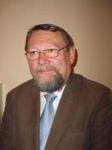
In his native town of Graz, Austria, he studied astronomy and gained his doctorate in July 1967 with a dissertation on the determination of stellar masses according to the Einstein's Theory of General Relativity (1915). After four years of duty as observatory assistant at the solar observatory of Kanzelhöhe, Carinthia, he accepted an invitation from the newly founded Institute of Astronomy at the University of Bochum, Germany, and became a member and research associate in February 1969. He thus gained access to the European Southern Observatory (ESO), which was inaugurated in that same year in Chile and has in the meantime become the largest and most reputable astronomical organisation in the world for terrestrial observation of the cosmos. At the end of 1976 he was integrated into the astronomical staff of the University Observatory in Vienna, Austria, and there after habilitation in 1980 he became an extraordinary professor in 1998.
He ran a campaign for Austria to join the ESO, which finally lead to a positive result in 2008, the year of his retirement. His research areas include young magnetic stars, galactic structure, including the interstellar medium, and the fastest young star of our galaxy, HIP 60350, a runaway from the neighbouring Andromeda galaxy.
With a special photometric technique he succeeded in discovering the first young magnetic stars in another galaxy, the Large Magellanic Cloud.
An Esperantist since 1961, president of TEJO in 1968, representative of UEA at the United Nations Office in Vienna since 1979, president of Aŭstria Laborkomitato Esperanto Centjara (ALEC) and main organiser of that organisation's university symposium in Vienna in 1987. In that role also a protagonist for the continuation of the International Esperanto Museum in Vienna as a special collection of the Austrian National Library in the mid 1980s. Head of the local committee of the World Esperanto Congress in Vienna in 1992 in extraordinary circumstances. A member of Akademio Internacia de la Sciencoj San Marino since 1983, and president of its senate since 2012. Currently president of Austria Esperanto-Federacio (AEF).
El Gazetaraj Komunikoj
UEA invitas prelegi en la 74-a IKU-sesio en Belfasto
Gazetaraj Komunikoj n-ro 912 (2020-10-20)
IKU-libro 2020: rekorde elŝutita
Gazetaraj Komunikoj n-ro 900 (2020-08-10)
Programo de la Internacia Kongresa Universitato (IKU) en Montrealo
Gazetaraj Komunikoj n-ro 856 (2020-03-19)
UEA invitas IKU-prelegantojn por Montrealo ĝis 15.01.2020
Gazetaraj Komunikoj n-ro 841 (2019-12-25)
UEA invitas prelegi en la 73-a IKU-sesio en Montrealo
Gazetaraj Komunikoj n-ro 823 (2019-09-11)
Aldonaj informoj
- Regularo pri Internacia Kongresa Universitato
- Taskoj kaj limdatoj pri IKU
- IKU kaj Esperanto en la scienco kaj tekniko (artikolo de Prof. Amri Wandel).
- La Akademio Internacia de la Sciencoj (prezento por la Almanako de UEA).
- [en] IKU and Esperanto in Science and Technology (in English)
- [fr] IKU et Espéranto dans les sciences et techniques (en Français)